
MANUFACTURING
Technical manufacturing for industrial temperature solutions
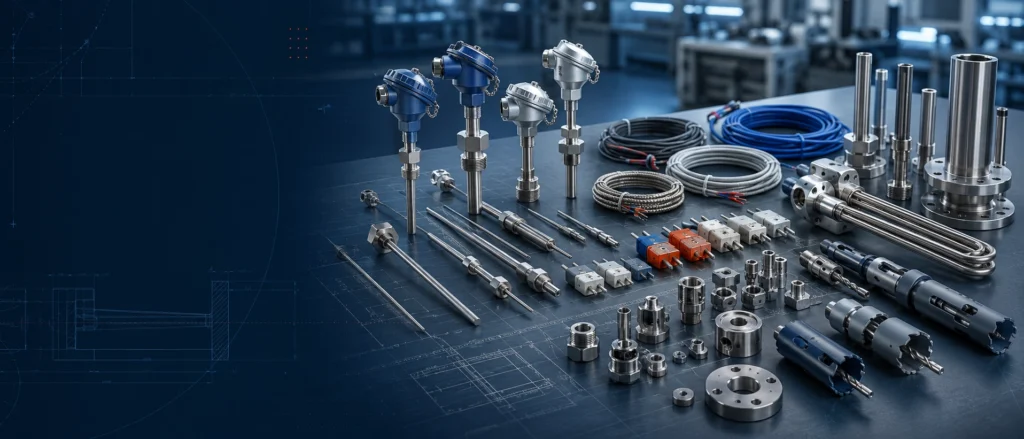
INDUSTRIAL TEMPERATURE LLC supports custom industrial temperature applications through a manufacturing and supply relationship with SILSE S.A. The product range includes thermocouples, RTDs, electric heaters, thermowells, cables, connectors and special technical components.
Each project starts with its operating conditions: temperature range, process environment, installation, materials, connection and the final application.
A process designed for reliability and accurate specifications
Manufacturing an industrial temperature component requires understanding the operating conditions, the purpose of the component and the customer’s technical requirements.
Our process combines initial assessment, technical validation, manufacturing or supply through the appropriate facility, and follow-up documentation. SILSE S.A. remains identified as manufacturer when it manufactures the product.
Technical assembly example
Industrial Temperature LLC · Nitride assembly
Need a custom-manufactured or adapted component?
Tell us about your application, operating conditions and the component you need to manufacture, replace or improve. We can review the technical requirements with you.
Need technical assistance?
Contact us before ordering, manufacturing or replacing a component. Provide the application, available dimensions, temperature range and relevant drawings or samples.
Technical inquiries: Sensors · Thermocouples · Electric heaters · Special components
info@industemp.com
info@industemp.com
OUR METHOD
Step-by-step process
We review the technical application, operating temperature, installation, materials, dimensions, connections and other service conditions before recommending a solution.
Objective: understand the actual requirement before choosing a product or manufacturing configuration.
We evaluate suitable products and configurations: thermocouples, RTDs, thermowells, heaters, cables, connectors and specialized components.
Objective: select the appropriate component for the application and avoid unnecessary compromises.
We verify critical technical data such as dimensions, operating temperature, sensor type, threads, materials, connections and mechanical protection.
Objective: ensure that the selected solution meets its real operating conditions.
Once specifications are agreed, manufacturing, assembly, adaptation or supply can proceed according to the materials, configuration and compatibility required.
Objective: deliver a reliable, functional industrial component appropriate for its intended application.
When applicable, drawings, data sheets, specifications and supporting documents accompany the supply to assist installation, verification and future repeat orders.
Objective: make the information clear for installation, maintenance and future replacement orders.
Technical review before manufacturing
Validate technical details before production
Small differences in dimensions, materials, threads or connection types can affect the performance of a complete industrial system.
Before a quotation or manufacturing order is finalized, critical requirements are reviewed and validated. This process helps reduce specification errors, rework and delays.
Validation checklist
Details to review before manufacturing
Operating temperature · Process or equipment · Exposure medium · Required length and diameter · Sensor type · Material and protective sheath · Threads or mounting method · Cable and connection type · Additional protection · Mechanical, thermal or environmental conditions · Drawings and technical requirements.
Technical documentation
Documentation for each technical solution
When required, projects may be supported by drawings, sketches, renderings, data sheets, reference samples or technical specifications.
Clear documentation helps with manufacturing coordination, verification, traceability, maintenance and future repeat orders.
Documents that may support the process
For dimensions, geometry, installation, threads, diameters, lengths and specific manufacturing details.
For product characteristics, materials, temperature range, connections, sensor type and general specifications.
To help clarify a specialized component, assembly or technical adaptation.
To assess compatibility, dimensions, wear, replacement options and possible improvements.